
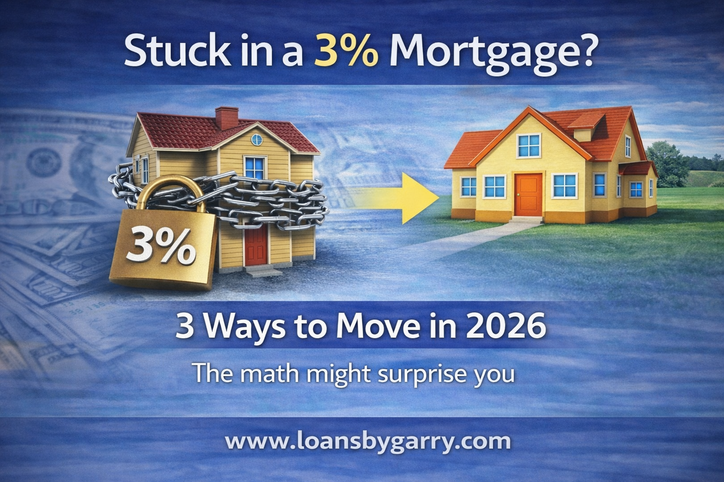
If you’re a California homeowner sitting on a 3% mortgage from 2020 or 2021, you’ve probably had some version of this thought: “I’d love to move, but I refuse to trade my rate for a 6 or 7.” You’re not alone. Economists have a name for this — the Mortgage Rate Lock-In Effect — and it’s kept millions of Americans frozen in place for the last three years.
Here’s the part most people miss: waiting it out is usually the most expensive choice on the table.
Let me explain what’s actually happening, and walk through three strategies my clients are using right now to move again without setting their finances on fire.
The Golden Handcuffs Problem
The lock-in effect happens when the gap between your current rate and today’s rates is so wide that moving feels like a demotion. You bought a $700,000 house in 2021 at 3%. Your payment is $2,952 a month. The idea of buying a comparable house today at 6.75% — where that same payment buys you a smaller loan — feels insulting.
So you stay. And you tell yourself, “I’ll just wait for rates to come back down.”
The problem with that plan: the historical average 30-year rate since 1971 is about 7.7%. Those sub-4% rates we had in 2020–2021? Those weren’t normal. Those were an anomaly created by a global pandemic and emergency Fed policy. Assuming they’ll return is like assuming every stock you own will go back to its all-time high — possible, but not something you build a life plan around.
Meanwhile, California home prices keep moving. Your family keeps growing. That commute keeps getting worse. Staying costs something too — it just doesn’t show up on a statement.
Three Ways to Escape the Lock-In
1. The Equity Offset
This is the strategy most rate-locked homeowners underestimate. Your rate is only part of your housing cost — the other part is how much you’re borrowing.
If you bought your house in 2020 for $600,000 and it’s worth $850,000 today, you have roughly $250,000 in appreciation sitting there. If your original loan was $480,000 and you’ve paid it down to $420,000, you’re walking into your next purchase with around $430,000 in equity after closing costs.
Drop $400,000 on your next home and your loan amount shrinks dramatically — which means a higher rate hurts you a lot less. The headline rate matters; the loan balance it’s attached to matters more.
2. Marry the House, Date the Rate
A classic because it works. If you find the right home — the school district, the yard, the commute, the layout — lock it up now while competition is still manageable. Rates aren’t forever. Refinancing is.
The key is running the numbers honestly upfront. I show clients their “if rates drop to X, here’s what we do” plan before we ever write an offer. That way, a future refinance isn’t a hope — it’s a preplanned move.
If rates drop even 75–100 basis points in the next 24–36 months (which most economists consider likely), you refinance and your monthly payment drops with it. You owned the house the whole time. You built equity the whole time. You didn’t get outbid by someone who showed up when rates finally moved.
3. Buy Before You Sell
This is the one a lot of homeowners don’t realize exists. Several of the lenders I work with now offer buy-before-you-sell or bridge-style programs that let you make a non-contingent offer on your new home using the equity in your current home.
Why this matters: in a market where inventory is finally starting to return (and sales are projected to rise meaningfully this year), being the buyer who doesn’t have a “sale contingency” gives you huge leverage. You can negotiate on price. You can move on your timeline, not the buyer’s. And you never have to do the stressful double-move through a rental in between.
This program isn’t right for everyone — there are costs and qualification requirements — but it has quietly solved the lock-in problem for a lot of my clients.
The Cost of Waiting: An $800K California Example
Let’s stop talking and do the math. Take an $800,000 home — a reasonable starter-family house in most of Orange County.
Scenario A: Buy today
- Purchase price: $800,000
- 20% down: $160,000
- Loan amount: $640,000
- Rate: 6.75% (today’s market)
- Monthly principal & interest: ~$4,150
Scenario B: Wait two years, hope rates drop to 5.75%, accept modest 5% appreciation
- Purchase price: $840,000
- 20% down: $168,000
- Loan amount: $672,000
- Rate: 5.75%
- Monthly principal & interest: ~$3,923
On the surface, Scenario B looks better — you’re saving about $227/month. But here’s the part nobody puts on the chart:
- Rent paid during the wait: ~$84,000 (24 months × $3,500/mo, conservative for OC)
- Appreciation that went to somebody else, not you: ~$40,000
- Principal you would have paid down in those two years: ~$14,500
Total cost of waiting: ~$138,500.
To recover $138,500 at $227/month in savings, you’d need to live in the waited-for house for over 50 years.
And that math assumes rates actually drop 1% in two years. If they don’t, or if appreciation runs hotter than 5%, the gap gets worse. Not better.
It Depends on You — Here Are the Questions to Ask
I’m not going to pretend one answer fits every household. Before you decide whether to move, run through these:
- How much equity is actually in my current house right now (not the Zestimate — a real number)?
- If I sold today and rolled that equity into a bigger down payment, what would my blended housing cost look like?
- Do I plan to live in the next house for 5+ years? (If yes, a future refinance has time to pay off.)
- Is my current home still the right fit for the next chapter of my life, or am I staying purely because of the rate?
- Would I tolerate a temporary 18–36 month stretch of a higher payment if it got me the right house on a preplanned refinance path?
If you answered “yes” to the last one, you’re probably a better candidate for moving than you think.
The Bottom Line
The lock-in effect is real, but it’s a math problem, not a prison. Between the equity you’ve built, the refinance path ahead, and buy-before-you-sell programs that barely existed five years ago, there are more ways to move in 2026 than most homeowners realize.
If you’re curious what your actual numbers look like — what your equity buys you, what the blended payment on your next house would be, and whether one of these escape paths fits your situation — send me a note. I’ll run the real numbers on your real house with today’s real rates. No pressure, no pitch. Just the math.
Garry McDonald
Loan Officer | Tried & True Home Loans
(949) 534-6686 | gmcdonald@triedandtruehomeloans.com
DRE# 01781703 | NMLS# 1922072