
Most temporary buydowns come with a catch.
Usually, somebody has to pay for them:
- the seller gives up part of their proceeds,
- the buyer brings in additional funds,
- or the builder quietly builds the cost into the price.
So while the payment may be lower for a year or two, somebody is still funding the difference behind the scenes.
But right now, there’s a program available through United Wholesale Mortgage (UWM) that works a little differently.
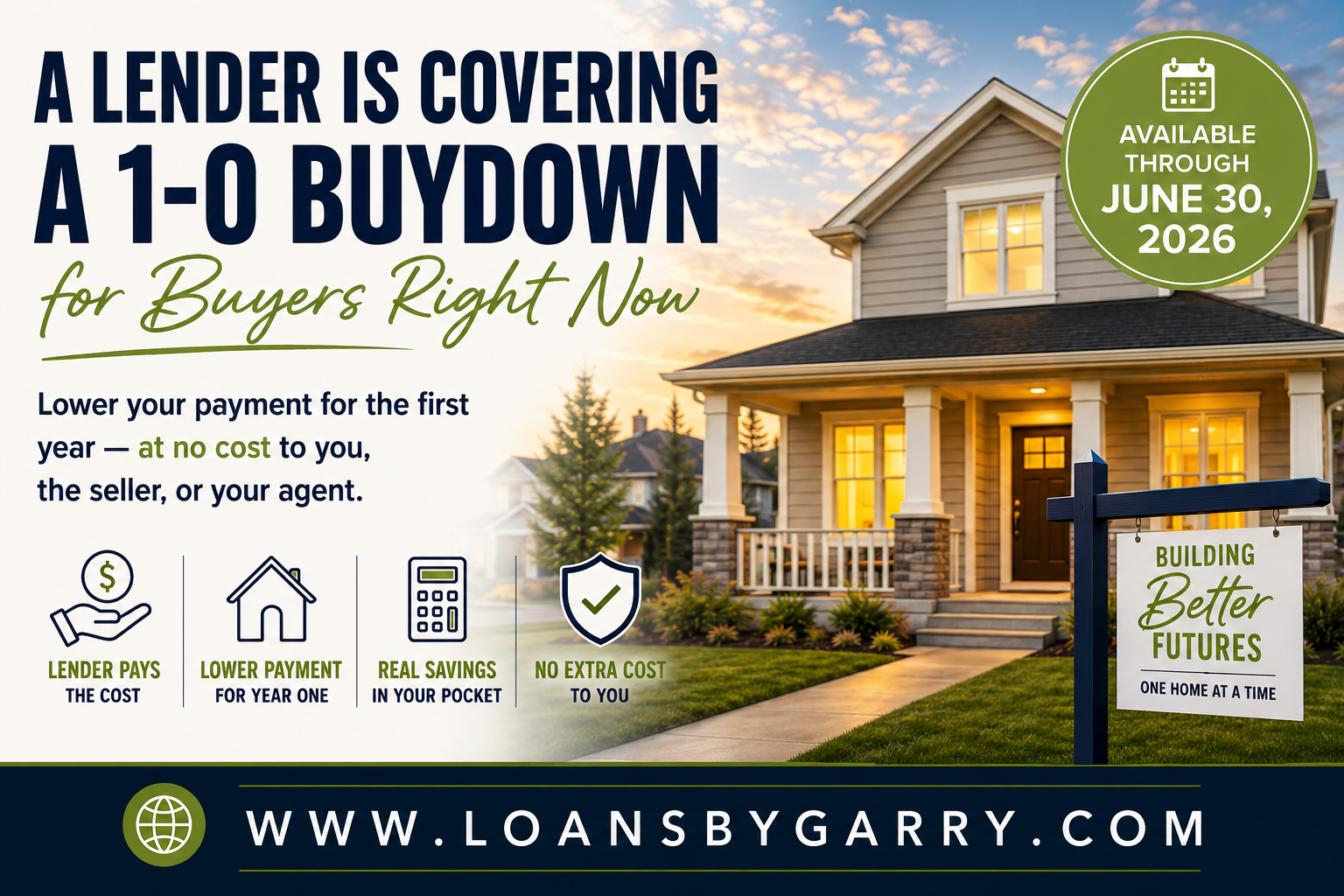
Through June 30, 2026, eligible buyers can receive a lender-paid 1-0 temporary buydown on certain conventional and government purchase loans (FHA, VA, and USDA). Instead of the buyer, seller, or agent paying for the buydown, the cost is covered through a lender credit.
For buyers trying to manage affordability in today’s market, that can create meaningful savings during the first year of homeownership.
How a 1-0 Buydown Works
A 1-0 temporary buydown lowers the effective interest rate by 1 percentage point during the first year only.
After month 12, the payment returns to the original note rate for the remainder of the loan term.
For example:
- Locked note rate: 6.5%
- Year-one effective payment rate: 5.5%
- Year two onward: back to 6.5%
Mechanically, the lender still receives the full payment every month. The difference between the lower payment and the full payment is funded through a buydown escrow account established at closing.
Traditionally, buyers or sellers funded that escrow account. In this case, the lender credit is covering it instead.
Real Numbers on a $500,000 Loan
Let’s look at a practical example.
- Loan amount: $500,000
- 30-year fixed rate: 6.5%
- First-year effective rate with buydown: 5.5%
Year One Payment
Principal and interest payment: approximately $2,839/month
Year Two and Beyond
Principal and interest payment: approximately $3,160/month
That creates a difference of roughly:
- $321 per month
- or about $3,857 over the first year
For many buyers, that first-year savings can provide some extra breathing room after closing without requiring additional seller concessions or higher out-of-pocket costs from the buyer.
Why the First Year Matters So Much
The first year of homeownership is usually the most financially demanding.
Even buyers who qualify comfortably often feel stretched after:
- down payment,
- closing costs,
- moving expenses,
- furnishing the home,
- repairs,
- appliances,
- landscaping,
- or unexpected maintenance.
That’s why temporary buydowns have become more popular recently. They’re designed to ease the transition into homeownership during the period when buyers tend to feel the most pressure.
A few hundred dollars a month may not seem dramatic at first glance, but over 12 months it can create a meaningful cash-flow cushion while buyers rebuild reserves and settle into the home.
And if rates improve during that timeframe, some borrowers may eventually choose to refinance before the buydown period even ends.
Why Lenders Are Offering Programs Like This
Affordability remains one of the biggest challenges in today’s housing market.
Many buyers can technically qualify for financing, but the monthly payment still feels uncomfortable compared to where rates were a few years ago.
Programs like this are designed to help reduce some of that initial payment shock without permanently restructuring the loan or artificially stretching qualification standards.
It’s not a workaround for affordability issues — it’s more of a short-term payment bridge during the transition into homeownership.
A Few Important Things to Understand
Before buyers get too excited, there are a few important details worth knowing.
You Still Qualify at the Full Note Rate
Underwriting qualifies the borrower using the full note rate payment — not the reduced year-one payment.
That’s actually a positive thing because it helps ensure buyers can still comfortably afford the home after the buydown period ends.
Purchase Loans Only
This particular lender-paid program applies to eligible purchase transactions, not refinances.
There’s a Deadline
The current promotion is scheduled to run through June 30, 2026, and loans generally need to be locked before that deadline.
The Interest Rate Is Not Permanently Reduced
The lower payment only applies during the first 12 months. Beginning in year two, the payment returns to the original note rate.
Who This Program May Help Most
This type of structure may work particularly well for:
- First-time buyers trying to preserve reserves
- Buyers expecting future income growth
- FHA or VA buyers looking for lower initial payments
- Buyers planning to refinance if rates improve
- Buyers who would rather use seller credits toward closing costs or repairs instead of rate buydowns
- Buyers who qualify comfortably today but want extra flexibility during year one
Where this generally does not help as much is for borrowers who are already extremely tight on qualification at the full note rate.
The Bottom Line
Programs like this don’t completely solve affordability challenges, but they can make the transition into homeownership more manageable for the right buyer.
A lender-paid 1-0 buydown can reduce the monthly payment during the first year without requiring additional contributions from the seller or increasing the buyer’s upfront cash requirement.
For buyers already considering a purchase this year, it’s worth seeing whether the numbers make sense for their situation.
If you’d like, I’m happy to run the scenario with your price range, down payment, and estimated payment so you can see both the year-one and long-term payment side by side.
Garry McDonald
Loan Officer | Tried & True Home Loans
(949) 534-6686 | gmcdonald@triedandtruehomeloans.com
DRE# 01781703 | NMLS# 1922072