
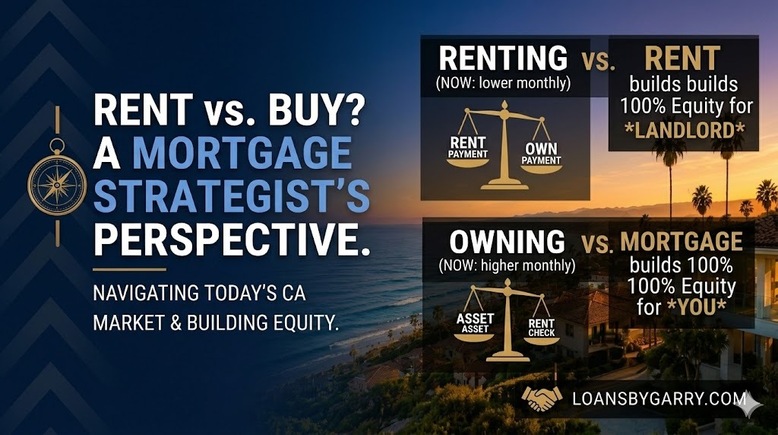
Let me start with the honest part: in most California counties right now, owning a home costs noticeably more per month than renting an equivalent one. That’s true. Anyone telling you otherwise is selling you something.
If you’ve been on the fence about buying because the monthly cash flow looks rough compared to your rent, you’re not being irrational. You’re reading the situation correctly.
But “renting costs less per month today” is not the same as “renting is cheaper long-term.” Those are two very different questions. And when you run the actual math out over 5, 7, 10 years — even without assuming appreciation — buying still wins more often than people expect.
Here’s how that math actually works.
The Honest Starting Point
Let’s use a realistic California scenario:
- Home purchase price: $800,000
- Down payment: 20% ($160,000)
- Loan amount: $640,000 at 6.5% (30-year fixed)
- Monthly principal & interest: approximately $4,043
- Property tax (1.0% effective): approximately $667/mo
- Homeowners insurance: approximately $150/mo
- Total monthly PITI: approximately $4,860
For a comparable rental — same neighborhood, similar size — let’s call it $3,500/mo.
So today, owning costs roughly $1,360 more per month than renting. That’s real. That’s the gap people are talking about.
If we stopped the analysis here, renting wins. But almost nobody actually rents the same place forever, and almost nobody pays the same rent forever. That’s where the math shifts.
Rent Doesn’t Stay the Same. Your Mortgage Does.
Here’s what most rent-vs-buy conversations skip: the rent number is not static.
Using a conservative 4% annual rent increase (California has historically run higher in most markets, but let’s keep it modest):
- Year 1 rent: $3,500/mo
- Year 5 rent: approximately $4,259/mo
- Year 10 rent: approximately $5,181/mo
Meanwhile, your mortgage payment — the principal and interest portion — doesn’t budge for 30 years. Taxes and insurance creep up modestly, but the bulk of your payment is locked in.
Watch the gap close:
- Today: rent $3,500, PITI $4,860 → owning costs $1,360 more
- Year 5: rent $4,259, PITI $4,860 → owning costs only $601 more
- Year 10: rent $5,181, PITI $4,860 → rent now exceeds your mortgage payment
By year 10 in this scenario, the renter is paying more per month than the owner — and they’re nowhere near done paying. The owner has 20 years left on a fixed payment. The renter has 20+ years of further rent increases ahead.
The Forced Savings Almost Nobody Counts
Every month you make a mortgage payment, a piece of it goes to principal — meaning a piece of it stays as your equity. You’re not paying it to a bank, you’re paying it to yourself in the form of a smaller loan balance.
On a $640,000 loan at 6.5% over the first 10 years, you’d pay down roughly $90,000–$100,000 in principal.
That’s $90,000+ you wouldn’t have if you’d been renting. It’s not invested in stocks, it’s not in a savings account, but it is real wealth tied up in the home. When you sell or refinance, that equity is liquid.
A renter making the same monthly outlay has nothing to show for it 10 years later — no principal balance shrinking, no equity building. Their $3,500/mo went 100% to their landlord’s wealth.
This is the part most rent-vs-buy spreadsheets undercount. Forced savings is real wealth, even when the monthly cash flow looks bad today.
What About Appreciation?
I’m not going to promise you the house will be worth more in 10 years. California has had stretches of flat or declining values (2007-2012, 2022-2023). Anyone who promises appreciation is selling you something.
But here’s the thing: the math above doesn’t require any appreciation to favor buying. The case is built on:
- Rent inflation (which is reliable, not speculative)
- Payment stability (a fixed-rate mortgage is a fixed-rate mortgage)
- Forced principal paydown (mathematical certainty)
If the home does appreciate at California’s historical 4-5% average, you’ve added significant additional wealth on top. If it doesn’t, the case still pencils. That asymmetry is the real reason to buy — not optimism about prices.
When Buying Doesn’t Make Sense
Honest list, because I’m not going to pretend it always works:
- You might move in less than 5 years. Transaction costs (closing, agent commissions, repairs) eat up the early-years benefit. The 5-year horizon is roughly the break-even point in most CA markets.
- The monthly payment genuinely doesn’t fit your budget. Forced savings doesn’t help if it forces you to live tight and stressed every month for years.
- You’re using all your reserves for the down payment. Buying a home without 3-6 months of cash left over is a recipe for getting wiped out by one major repair.
- The job or relationship situation isn’t stable. Renting buys flexibility, and flexibility has real value.
If any of those apply to you, the smart move is probably to keep renting — at least for now.
Who This Works For
Buying makes the strongest mathematical sense if:
- You plan to stay 5+ years
- The PITI fits comfortably in your budget
- You have reserves left over after the down payment
- You’re not in a market where rent is unusually depressed vs. ownership (a few hyperlocal pockets in CA right now)
- You value payment stability over flexibility
The Bottom Line
The monthly gap between renting and owning in California is real today, and pretending it isn’t would be dishonest. But that gap closes faster than people realize — and the wealth you build through principal paydown shows up whether or not the market cooperates with appreciation.
If you want to see what these numbers actually look like for the neighborhood you’re considering — your specific price point, your rent comparison, your time horizon — I’m happy to run it side-by-side with you. No pressure, no pitch. Just the math.
Sometimes the math says rent. Sometimes it says buy. Either way you’ll know.
Garry McDonald
Loan Officer | Tried & True Home Loans
(949) 534-6686 | gmcdonald@triedandtruehomeloans.com
DRE# 01781703 | NMLS# 1922072